I hear the term ‘command’ all the time when talking to clients – and nobody has meant anything bad by it. It’s just a word we all used to use when referring to dog training.
So why does it matter? Isn’t it just semantics? Well, yes, in a way it is. But semantics matter – the implications of a particular word can influence us in the way we behave.
A command is an order – a directive that must be obeyed. Failure to obey normally results in punishment. Commands are always in a downward direction – we don’t command anyone above us (socially, in employment and so on) but those ‘below’ us (smaller, earning a smaller salary, ranked lower etc).
There’s a reason they removed the word ‘obey’ from the marriage service.
Just glancing at some of the words and phrases linked with ‘command’ in the dictionary highlights the meaning associated with this word: ‘authoritative’, ‘peremptory order’, ‘dominate’, ‘the ability to use or control’ – it’s all about being in charge, enforcing obedience, having power.
I’d like to think the world has moved on a bit. Not only did I use commands with my previous dogs, I used them with my children and the pupils I taught during my time as a secondary school teacher.
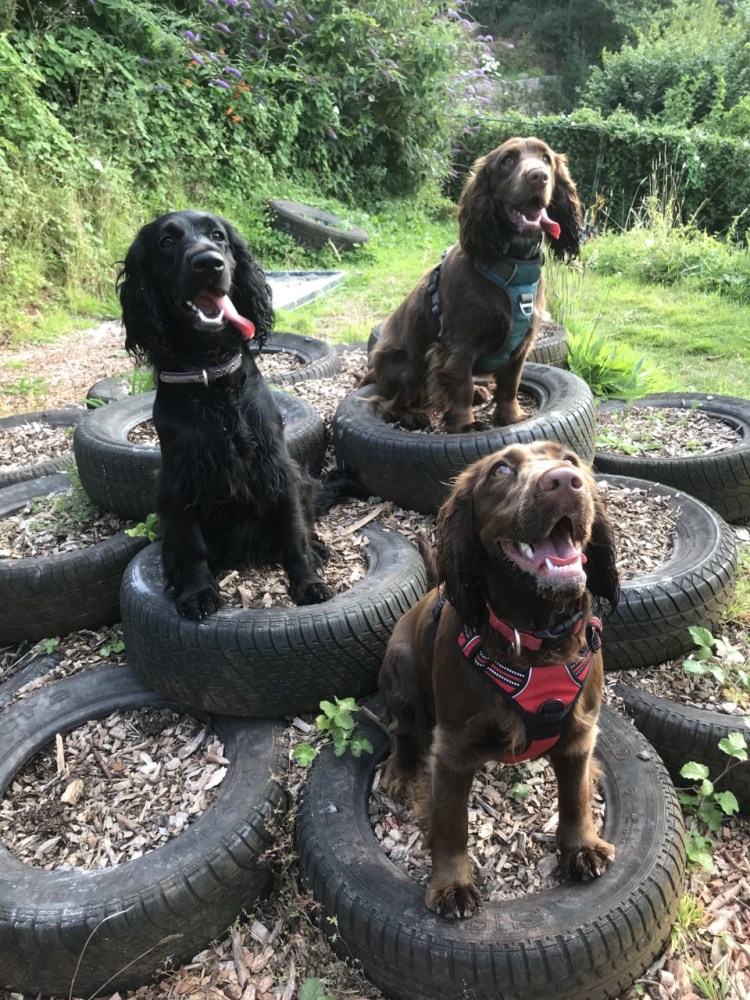
There’s no way of running a control experiment now; my children are bringing up their own and my former students are taking theirs to school, but I’m sure of one thing: my current dogs, who have been raised with cues rather than commands, are better-‘trained’ than all my much-loved earlier canine companions.
Are they perfectly-behaved? Absolutely not! But more responsive, and keen to learn, play and train – yes, definitely.
So, is all of this down to just changing the word ‘command’ to ‘cue’? No, it’s not. It’s what I understand by the two different terms.
When I first had my own dogs, we bought choke-chains to walk them. A few years later, these same devices were marketed as check-chains and no shop used the old labels. The collars hadn’t changed a jot – just the name.
But here’s the thing: people started to realise the implications of putting a ‘choke-chain’ on their dogs – that you intended to choke them in order to teach them not to pull on the lead. It was, however, felt acceptable to ‘check’ your dog – never mind that you were actually still potentially choking them, with a metal chain.
(And no, for the record, it didn’t work – unless you were strong enough to choke the dog sufficiently to force it to comply. That’s not how I want to ‘control’ a dog.)
I sometimes think that this was the start of the semantics revolution – and although this tiny step, on its own, didn’t make much difference, perhaps it made some people consider what the basic function of a chain collar was, and to begin to look for alternatives.
As for children (and colleagues, for that matter), I would like to think that I’d have got some better results if I’d known more about learning theory and the power of positive reinforcement. Not that my own children aren’t wonderful – they really are! But I sometimes think that’s in spite of their upbringing rather than because of it.

One word that comes up in association with ‘command’ is ‘dominate’ – here we go again, back to that old favourite, the Dominance Theory.
Not only has this been widely discredited, with many newer scientific studies showing that it’s not a thing, it returns us to the hope that we’ve grown a bit in the last couple of decades.
Do we want to dominate people? Children? Employees? Do we want to dominate our dogs? Or would we rather make an effort to understand them and then work in partnership with them?
In a recent blog post, Victoria Stilwell talks about the concept of respect – how important it is to us humans, and how the idea of a dog not respecting us is still bandied about by people who think we should be the pack leader (see comments above regarding dominance theory, and I wish I knew how to insert a rolling-eye emoji here).
She points out that, for all their amazing attributes, dogs don’t have the cognitive ability to understand or feel respect. They can like us or dislike us. They can trust or fear us. They can’t respect – or disrespect – us.
Dogs do what works. For them. If we want to influence this, in order for our dogs to fit more comfortably into our human world, we need to learn how to make the right things work for the dog. Giving them a command and expecting them to obey because we’re the masters just doesn’t sit right with me.
Steve Mann, founder of the IMDT, recently said that there are two possible reasons why your dog isn’t doing what you’ve asked – and neither of them are that he disrespects you or is choosing to disobey. Either he doesn’t understand or he’s not sufficiently motivated.

Once you think about it like this, a command is pretty pointless. So instead, we can teach, reinforce and use a cue to prompt a behaviour and evaluate the outcome bearing these criteria in mind. Kinder, clearer and more effective.
References:
http://www.dogsactually.com/dog-training/debunking-the-dominance-theory-in-dog-training
https://positively.com/victorias-blog/does-your-dog-respect-you/
 Homefield K9 Training
wow!! 15Cue or Command?
LikeLiked by 1 person